
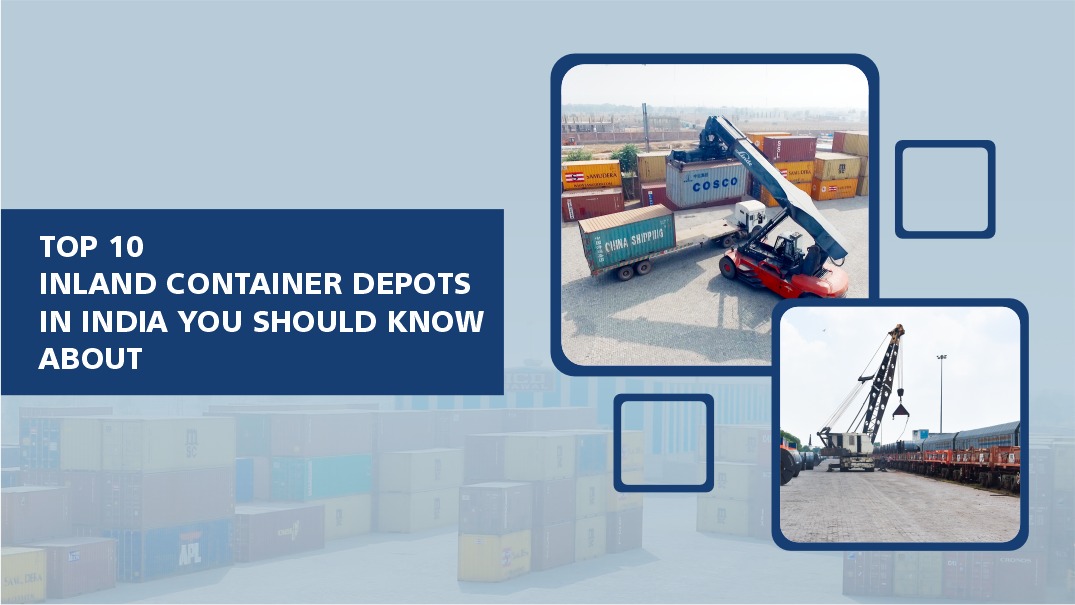
Top 10 Inland Container Depots in India You Should Know About
The efficient functioning of export-import supply chains in India hinges on a robust network of inland container depots (ICDs), also known as dry ports, which enable hinterland businesses to handle customs clearance, container storage and multimodal transport without direct reliance on seaports.
What Is an Inland Container Depot (ICD) and How Does It Work?
An Inland Container Depot (ICD) is defined as a common-user facility with public-authority status, equipped with fixed installations for handling and temporary storage of import/export laden containers as well as empties, under customs control. These depots provide services including container stuffing/stripping, storage, customs clearance, warehousing and transit operations by rail or road. A business can move containerized shipment from hinterland to port (or vice versa) via ICD thereby reducing congestion at seaports and streamlining logistics through multimodal connectivity.
Why Are Inland Container Depots Critical for India’s Supply Chain?
- **Decongestion of seaports:** By shifting customs clearance, container handling and temporary storage inland, ICDs relieve pressure on coastal ports and help manage high traffic.
- **Cost-effective logistics and flexibility:** For manufacturers and exporters located far from the coast, ICDs provide local access to containerised transport, reducing hauling costs for empty containers, demurrage charges and transit time.
- **Hinterland connectivity and integration:** ICDs help integrate hinterland industrial areas with major ports via rail or road, enhancing reach of exporters/importers across inland India.
- **Customs clearance & consolidation services:** With customs clearance, LCL consolidation, warehousing, container maintenance and repair facilities, ICDs act as full-service logistics hubs.
Criteria for Ranking the Top Inland Container Depots in India
- Strategic hinterland connectivity (rail/road links to major ports and industrial belts)
- Volume and historic significance in EXIM trade
- Infrastructure & services (customs clearance, warehousing, container handling, connectivity)
Major Inland Container Depots (ICDs) in India
ICD Tughlakabad (New Delhi / NCR)
Located at New Delhi (Haryana), ICD Tughlakabad (TKD) is widely regarded as India’s largest ICD. It serves as a major container hub for Delhi NCR and northern hinterland. It connects to major ports such as Jawaharlal Nehru Port (JNPT), Mundra Port and Pipavav via rail or road enabling efficient inland-to-port and port-to-inland movement of consignment.
ICD Dadri (Greater Noida / Western UP)
ICD Dadri is positioned to serve the industrial and export/import needs of western Uttar Pradesh and NCR outskirts. Among its advantages: LCL consolidation services, container handling and improved transit access as it lies outside Delhi city limits — helping businesses avoid Delhi’s vehicular restrictions.
ICD Sabarmati (Ahmedabad, Gujarat)
ICD Sabarmati is a major hinterland gateway for western India. It was established by the state container operator and has emerged as one of the largest ICDs in Western India in terms of shipment handled.
The depot provides comprehensive customs clearance, warehousing, container stacking and multimodal connectivity, enabling exporters/importers in Gujarat and nearby regions to access coastal ports efficiently.
ICD Whitefield (Bengaluru, Karnataka)
Serving Karnataka and South India hinterlands, ICD Whitefield extends containerised freight services to regions that would otherwise face lengthy transport to seaports. It plays a critical role in linking southern industrial hubs with ports on west and east coasts.
ICD Nagpur (Nagpur, Maharashtra / Central India)
ICD Nagpur covers central India including Vidarbha and adjoining hinterlands. It serves as a strategic multimodal connector, offering rail and road links to major ports and acting as a central hub for consignments from interior India.
ICD Sanathnagar (Hyderabad, Telangana / South-Central India)
ICD Sanathnagar is the major container terminal for South-Central India, connecting Telangana, Andhra Pradesh, Karnataka and Odisha hinterlands. It offers warehousing, customs clearance, container stacking and rail-road connectivity to ports. It has container-stacking capacity for thousands of TEUs and supports EXIM consignments, along with domestic shipment.
ICD Ludhiana (Dhandari Kalan) (Punjab / Northern Industrial Belt)
ICD Ludhiana, also listed as “Dhandari Kalan” caters to Punjab and neighbouring industrial regions, supporting textile, manufacturing and export industries in the region.
Through rail-linked container movement to ports such as JNPT or Mundra, it enables efficient transport of consignments, thus supporting the supply-chain requirements of North-West India.
ICD Kanpur (Uttar Pradesh / Central-Eastern Uttar Pradesh Corridor)
ICD Kanpur serves central and eastern parts of Uttar Pradesh, providing inland container services and hinterland connectivity for exporters in the region. Such ICDs are critical for balanced regional distribution of logistic infrastructure, reducing dependence on congested northern or western hubs.
ICD Coimbatore / Tamil Nadu & South Industrial Belt
ICD Coimbatore caters to Tamil Nadu and southern manufacturing hubs. It extends containerised logistic benefits, customs clearance, storage, container handling to regions distant from major ports, bridging the gap between hinterland and coast.
ICD Moradabad (Uttar Pradesh / Northern Hinterland)
ICD Moradabad provides inland container services to industrial clusters in UP and northern India. Its inclusion ensures coverage beyond major metros, offering logistics infrastructure for growing manufacturing and export units in smaller cities.
The Emergence of ICD Bawal (Sanjvik Terminals) as a Northern India Leader
While national-level ICDs form the backbone of India’s container logistics, newer facilities like ICD Bawal operated by Sanjvik Terminals, highlight how strategically located inland depots reinforce logistic resilience for hinterland industries.
Sanjvik Terminals an ICD in Bawal as a leading dry port in northern India, offering multimodal transport, customs clearance, warehousing and terminal management.
ICD Bawal boasts strong connectivity: proximity to major national highways (NH-48), rail access linked to freight corridors (WDFC) and seamless links to coastal ports and airports.
For hinterland customers in Haryana, Rajasthan, Western UP and surrounding regions, ICD Bawal reduces the dependence on congested seaports, cuts transit time and provides efficient container handling.
How ICDs Like These Integrate Road, Rail, Port Connectivity and Customs Clearance Services
ICDs succeed because they combine multiple logistic functions in one place:
- **Multimodal connectivity:** Most ICDs are rail-linked and often connected to national highways, enabling movement of containers by rail or road to ports or destinations.
- **Customs clearance & warehousing:** ICDs serve as customs-notified zones where import/export consignments are cleared, containers are stored and intermediate consolidation (especially for LCL shipment) is done.
- **Container maintenance & empty container management:** They manage empty container storage, container repairs, thereby reducing dead-haul and demurrage, a critical operational cost for exporters/importers.
- **Hinterland access:** Industries located far from coast benefit from proximity to an ICD rather than being forced to send containers directly to ports. This improves lead time, lowers costs and adds flexibility.
Future Trends and Growth Potential for Inland Container Depots in India
- **Expansion of private & PPP-based ICDs:** With industrial growth across hinterland India, more private dry ports like ICD Bawal are expected to emerge. This will increase reach of container logistics to non-metropolitan industrial zones.
- **Multimodal infrastructure & freight corridors:** As rail freight corridors expand and road networks strengthen, more ICDs will leverage rail + road + port connectivity, reducing dependence on coastal congestion.
- **Enhanced customs & clearance efficiency:** Modern ICDs will continue to integrate advanced terminal-management systems, E-filing and customs processes, thus reducing turnaround time and improving reliability.
- **Support for diversified industries and hinterland exporters:** As manufacturing spreads beyond traditional hubs, ICDs will play a key role in enabling export/import logistics from emerging industrial belts, especially in central, eastern and northern India.
Conclusion
Inland Container Depots from traditional giants like ICD Tughlakabad, ICD Sabarmati, ICD Whitefield, or ICD Sanathnagar to emerging dry ports like ICD Bawal, form the backbone of India’s supply-chain infrastructure. They provide hinterland industries with efficient, cost-effective access to containerized transport, customs clearance services, warehousing and multimodal connectivity. As India’s manufacturing and export landscape evolves, ICDs will continue to play a pivotal role in shaping a modern, resilient logistics ecosystem.