
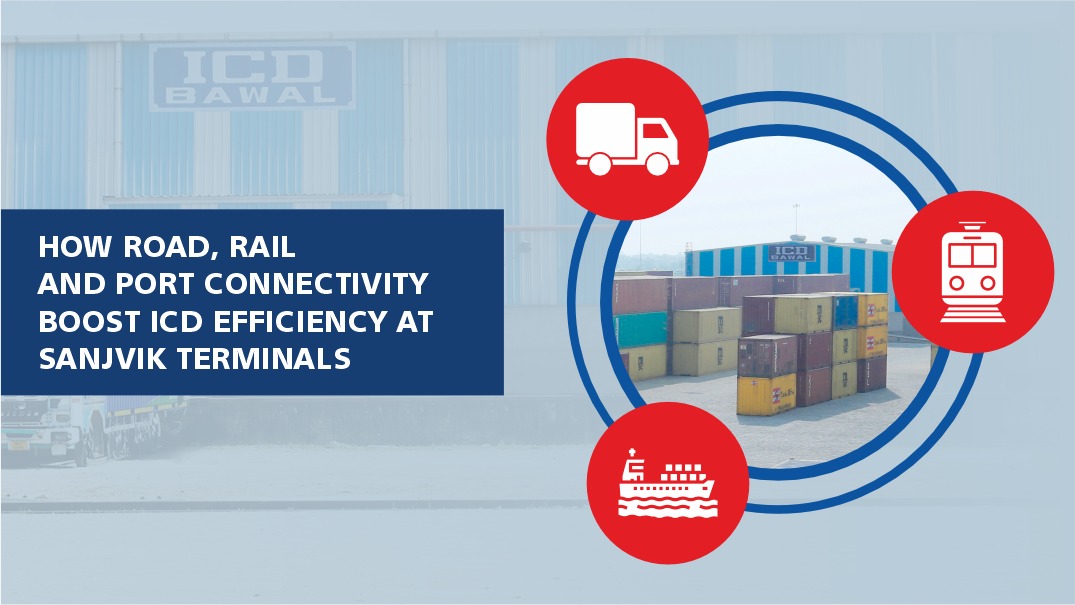
How Road, Rail and Port Connectivity Boost ICD Efficiency at Sanjvik Terminals
What Is Multimodal Connectivity and Why Is It Important for ICDs?
Multimodal connectivity refers to the integration of two or more transport modes under a coordinated logistics network. This approach enables a seamless transition of consignment across different means of transport without disruption, reducing handling delays, optimizing cost and enhancing speed and reliability.
For inland container depots (ICDs) or dry ports, multimodal connectivity is vital because it links hinterland industrial clusters with major seaports and export-import gateways, thereby enabling efficient consignment movement between production hubs and international trade corridors. By combining different modes of transportation in logistics road, rail and port (sea) multimodal logistics provide flexibility to choose the most cost-effective and time-efficient route for each consignment, depending on origin, destination, type and urgency.
Overview of Sanjvik Terminals: Strategic Location and Infrastructure
Sanjvik Terminals Pvt. Ltd. is positioned as an inland container depot (ICD) meant to serve the hinterland efficiently. Its strategic value lies in leveraging multimodal connectivity to facilitate smooth consignment movement across India, especially between hinterland markets and seaports or consumption centers.
Given the rising importance of integrated logistics frameworks in India, supported by policies encouraging multimodal transport and dedicated freight corridors, Sanjvik is well placed to act as a key node in nationwide supply chains.
How Road Connectivity Enhances shipment Movement to and from Sanjvik ICD
Road connectivity remains the backbone of first-mile and last-mile consignment movement. For Sanjvik, robust road links ensure that consignments from industrial clusters and manufacturing hubs in the hinterland reach the ICD quickly. From the ICD, road connectivity enables distribution to final destinations (factories, warehouses, retailers) that might not lie along railway tracks or direct sea-port links.
This flexibility of road as a mode of transport ensures that consignments, irrespective of their origin or destination, can be handled efficiently, making the ICD a central consolidation/deconsolidation point before onward transport.
Moreover, in a multimodal network, road connectivity complements other modes: where rail or sea might be efficient for bulk and long-haul, road ensures reach to remote or last-mile locations.
The Role of Rail Networks in Streamlining Container Transport
Rail connectivity brings significant advantages for long-haul, bulk and containerized consignment movement. For example, the recently developed Western Dedicated Freight Corridor (WDFC) offers a high-capacity, electrified rail network connecting major industrial regions (including northern and western hinterlands) to western coast seaports.
The benefits of rail connectivity via WDFC (or similar rail networks) include:
- **Reduced transit time:** Dedicated freight corridors enable longer, heavier, double-stack container trains, reducing overall transit time compared to older mixed-use lines.
- **Higher throughput and capacity:** Rail trains on these corridors can carry numerous containers at once, increasing volume moved per trip and reducing congestion.
- **Lower logistical cost:** Rail-based freight tends to be more cost-effective per ton-km over long distances compared to road transport, particularly when consignments are containerized.
- **Consistency and reliability:** Dedicated corridors reduce unpredictability from traffic congestion, road conditions and delays enabling scheduled freight movement.
Port Connectivity: Linking Inland Operations to Major Seaports
Port connectivity is critical for export/import consignments. By linking inland container depots like Sanjvik ICD to major seaports, consignments can move seamlessly between hinterland production bases and international shipping gateways. This ensures that consignments destined for export or arriving via ports can be transported inland efficiently without repeated handling or unnecessary delay.
The concept of ICDs functioning as dry ports acts as inland transshipment points for consignments between inland hinterland and maritime ports, while offering services such as unitization, storage, customs clearance and container handling. By facilitating port-ICD linkage, Sanjvik enables exporters and importers to utilise port infrastructure more efficiently, avoid congestion at seaport terminals and benefit from quicker shipment movement across the hinterland.
How Multimodal Logistics Reduce Transit Times and Costs at Sanjvik
By combining road, rail and port transport modes, multimodal logistics at Sanjvik offer multiple advantages:
- **Cost-effective long-haul transport:** Rail or sea for long distances + road for first/last mile reduces overall per-ton-km cost compared to road-only logistics.
- **Faster turnaround:** Dedicated corridors and seamless mode changes reduce transit time, enhancing reliability.
- **Lower risk of delays and congestion:** Rail and sea bypass road traffic and congestion; ports and ICDs reduce pressure on coastal terminals; integrated scheduling reduces wait times.
- **Simplified operations and better asset utilization:** Use of double-stack container trains, standardized containerization and centralized ICD operations improves throughput and reduces handling complexity.
Impact of Western Dedicated Freight Corridor on Sanjvik ICD Efficiency
The Western Dedicated Freight Corridor (WDFC) plays an important role in upgrading rail-based freight logistics across the western and northern hinterland, linking them to western seaports.
For an ICD like Sanjvik, whose hinterland may overlap with regions served by WDFC, this means:
- Access to faster, high-capacity rail freight services
- Reduced transit times for containerised consignments to and from ports
- Lower logistic costs due to double-stack container trains, high axle-load tracks and efficient scheduling
- Ability to offer customers a robust multimodal alternative, reducing dependency on road-only transport
Seamless Coordination among Various Transport Modes at Sanjvik
Multimodal operations at Sanjvik require coordination between road carriers and rail transport. Such coordination ensures that consignments are transferred between modes with minimal dwell time, proper documentation and adherence to customs and clearance procedures.
Benefits to Businesses: Faster Customs Clearance and Reduced Delays
For customers using Sanjvik ICD, multimodal connectivity translates into tangible benefits:
- Faster transit of consignments across long distances, reducing lead-time
- Lower freight and logistics costs compared to exclusive road transport over long haul
- Predictability and reliability in delivery schedules due to coordinated rail & port linkages
- Efficient container handling and customs clearance at inland location, reducing pressure on seaports and lowering dwell time at ports
- Flexibility to choose transportation mode depending on urgency, cost and type of consignment
This enhances overall supply-chain efficiency and makes Sanjvik an attractive proposition for businesses requiring seamless multimodal logistics.
Future Plans to Enhance Connectivity and Capacity at Sanjvik Terminal, ICD
Looking ahead, further strengthening of multimodal infrastructure through enhanced rail network access, better road linkages and streamlined port connectivity can increase Sanjvik’s capacity to handle a larger volume of containerized shipment.
How to Leverage Sanjvik Terminals’ Multimodal Connectivity for Your Business
Businesses seeking efficient supply-chain solutions can route consignments via Sanjvik to gain from multimodal logistics:
- Choose rail for long-haul transport, complemented by road for first- and last-mile delivery.
- Use ICD as a consolidation/deconsolidation point to optimise container utilization.
- For export/import operation, take advantage of ICD-port connectivity to avoid congestion at seaports and reduce delays.
Conclusion
Multimodal connectivity integrating road, rail and port transport significantly enhances the effectiveness of an inland container depot such as Sanjvik. By leveraging different modes of transportation in a coordinated manner, Sanjvik turns into a dynamic logistics hub that offers flexibility, speed, cost-efficiency and reliability for a wide spectrum of consignment types. For businesses operating across India’s hinterland, Seaboard gateways and industrial zones, Sanjvik stands out as a strategic choice to streamline supply-chain operations, reduce transit times and costs and ensure dependable delivery.